Deceptive and misleading advertising involves the act of introducing a product that creates a fraudulent and false impression towards consumers, which can ultimately lead to major negative consequences to a business. The amount of trust an individual has on an advertisement has become increasingly scarce as the amount of deceiving and misleading advertisement cases have amplified. It is completely up to a consumer whether they believe or discard the proposal of a product. The false or misleading information can be founded in a business’s advertisement, product packaging and/ or information that is exposed by either staff or online shopping assistances verbally/ digitally. Additionally, this is also applicable for businesses that function on the internet, meaning no false information can be included on their websites or social media platforms. If a business’s product creates a false and misleading impression in the mind of their consumers through their advertisement, promotion, quotation and/ or statement about their product’s pricing, value or quality of goods/ services, this would more than likely mean the business has participated in an infringement of the law and would be reported to either the ACCC (Australian Competition and Consumer Commission) or Ad Standards. There are two cases from Nurofen and Samsung, where the act of deceptive and misleading advertising is clearly exploited.
Ad Standards are responsible for cases of deceptive and misleading advertisements that involve marketing about food and beverages, towards children as a target market or referring to environmental claims in an unfair manner.
The Australian Competition and Consumer Commission are responsible for any other type of deceptive and misleading advertising and support the need for endorsing fair trade and competition in any business market with the objective to value all consumers, businesses and the society, even if it is unintentional.
- The most common type of false and misleading advertising includes:
- Fine print (this involves advertisements that include information in very little writing. This can be intentionally done by a business to purposefully make it difficult for consumers to read and contradict the general message of the advertisement. This is usually implemented when a business wants to hide true information that they suspect would impact a consumer’s choice in a negative way.)
- Comparing advertisements (including advertisements that compare their goods/ services with other products within the same market. This can include a product’s quality, price, range or volume. If the claim of the other business is incorrect or used inappropriately to disadvantage the other company, it can be considered misleading and involvement of unfair practices.)
- Bait advertising (this is when a business promotes their products for sale at a low price with the objective to increase attention of consumers. However, this can be considered illegal when businesses advertise their goods or services for a discounted price when the product is not available in the precise amount and period of time at that particular lower price.)
- Environmental claims (this involves businesses claiming they are environmentally friendly in their advertisements when in reality, they are not.)
Nurofen Case Study
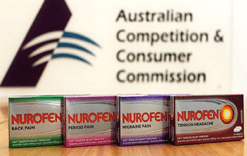
Nurofen manufacturers were fined $6 million by the Federal Court for alleged deceptive and misleading advertising towards their consumers. A pharmaceutical giant, Reckit Benckiser loses the case against the Australian Competition and Consumer Commission as the Federal Court discovered the products including misleading information by containing the exact same ingredient and undertaking the same performance as every other Nurofen product, although it is claimed to be a “specific pain” assortment. The “specific pain” range stated to aim for exclusive areas of the body such as; back pain, migraine, tension headaches, period pains, whilst it contained ingredients that were identical in any other ordinary ibuprofen. Furthermore, the “specific pain” range additionally were higher in price to the regular Nurofen. The appeal justices stated; “Contrary to the representations, ibuprofen does not target any particular type of pain. It treats all types of pain precisely the same way.” -Jagot, Yates, Bromwich and additionally affirmed that the Nurofen’s products were “inherently misleading”. By 2015 the Federal Court made sure the specific pain range Nurofen products were removed from all retail stores and Nurofen furthermore shared corrective announcements in both newspapers and their websites to clearly state the truth about the “specific pain” assortment.
Samsung Case Study
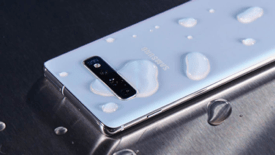
The Australian Competition and Consumer Commission launched procedures in the Federal Court alleging Samsung being found guilty for deceptive and misleading advertising in terms of their ‘water-resistant’ Galaxy mobile phones. More than 300 advertisements viewed people swimming in pools and surfing in the ocean with these Galaxy mobile phones, declaring that their product was water resistant to 1.5 metres for up to 30 minutes. The Australian Competition and Consumer Commission discovered the mobile phones were not appropriate for any interference with the water, and the phone life would be severely disturbed if it were exposed to water. This therefore is another example of major involvement with deceptive and misleading advertising. The Galaxy mobile phones were additionally priced higher compared to their other products that were so-called ‘non-water’ resistant. The Australian Competition and Consumer Commission chair Rod Sims claimed, “Samsung showed the Galaxy phones used in situations they shouldn’t be to attract customers,” and furthermore stated, “Samsung’s advertisements, we believe, denied consumers an informed choice and gave Samsung an unfair competitive advantage.” Samsung had sold more than 4 million Galaxy mobile phones in Australia that had been deceptively and misleadingly attracting the attention of consumers through their claim of the water-resistant feature.
McDonald’s Case Study

McDonald’s were obligated to remove their mobile app targeted for children after infringing the law of Ad Standards. The app ‘Happy Studio’ had over a million downloads and was aiming their target market for kids aged within 6-12. It included video games that allowed children to design their own Happy Meal to whatever they wished for. However, Maccas was targeted for claiming they only were displaying ‘healthier’ options, such as chicken wraps, apple slices and milk that is flavoured, whilst in reality the meals were unhealthy. Therefore, the business was responsible for infringing the Quick Service Restaurant Initiative (QSRI) for Responsible Advertising and Marketing to Children.
Overall, the cases; Nurofen, Samsung and McDonald’s illustrate the ways a business can possibly undertake the infringement of deceptive and misleading advertising. Through the false claims of targeting the specific area of the body in medicine and the feature of water-resistant phones are just two of several ways a business can be targeted for breaching deceptive and misleading advertising. Major consequences are taken place for a business that involves itself with this illegal act to attract various targeted consumers. It additionally displays the big involvement of the Federal Court, Australian Competition and Consumer Commission and Ad Standards in taking place to force penalties on the business which can severely impact their reputation amongst their targeted consumers and the revenue they’re generating through the fines that are needed to be funded as a consequence.
SITES
Josh Loh, Marketing; Ad Standards cases of 2019 so far – accusations and brands cross the line, viewed 12 April 2019, https://www.marketingmag.com.au/news-c/news-ad-standards-2019-cases-april/
ACCC, Samsung in court for misleading phone water resistance advertisements, viewed 4 July 2019, https://www.accc.gov.au/media-release/samsung-in-court-for-misleading-phone-water-resistance-advertisements
Danielle Long, The Drum; Samsung Australia sued by consumer watchdog for misleading advertising, viewed 12 July 2019, https://www.thedrum.com/news/2019/07/12/samsung-australia-sued-consumer-watchdog-misleading-advertising
Nick Dole, ABC news; Nurofen fined $6m for misleading consumers following ACCC case over ‘specific pain’ range, viewed 16 December 2016, https://www.abc.net.au/news/2016-12-16/nurofen-fined-6m-for-misleading-consumer/8126450
Ad Standards, Misleading and deceptive advertising, https://adstandards.com.au/issues/misleading-and-deceptive-advertising
ACCC, False or misleading claims, https://www.accc.gov.au/consumers/advertising-promotions/false-or-misleading-claims
ACCC, Advertising and selling guide, https://www.accc.gov.au/publications/advertising-selling/advertising-and-selling-guide/avoid-misleading-or-deceptive-claims-or-conduct/misleading-or-deceptive-conduc
 allegraslovitt.com